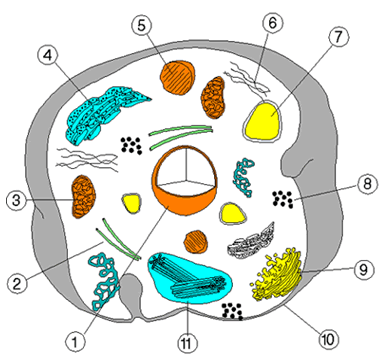
1. Cell:
A cell consists of three main parts---the ______________, the cell "stuff"
called ______________, and the outer _________________________.
2. Cell Membrane: The cell membrane is extremely _________and is __________________
permeable.
function: The cell membrane regulates the_________________________________________,
participates in signal transduction, and helps cells adhere to other cells
structure: The basic framework of the cell membrane consists of a double layer
of _________________
_________________ are found in the cell membrane, including some which are transmembrane
and some that are peripheral membrane.
3. Cytoplasm: The cytoplasm consists of a clear liquid called ______________________,
a supportive ____________________________, and networks of membranes and organelles.
4. endoplasmic reticulum: provides a tubular __________________________ system
inside the cell.
rough: why does it appear rough? ________________________
What does it function in the synthesis and transport of? _____________________
smooth: Why does it appear smooth? _____________________
What does it function in the transport of? _____________________
5. ribosome: Where are they found? _____________________
What are they composed of? _____________________
What do they help in the production of? _____________________
6. golgi apparatus: is composed of flattened __________and it packages the
cells products.
These packages are released in the form of ________________________
7. lysosomes: contain __________________ enzymes to break up old cell components
and bacteria.
They are sometimes called the "______________________________" of
the cell.
8. microfilaments and microtubules: are thin threadlike structures that serve
as the _________________________________of the cell.
Microfilaments, made of the protein ____________________, cause various cellular
movements.
Mictotubules, made of the globular protein _________________.
9. centrosome: is a structure made up of two hollow cylinders called ________________________.
What is their function?
10. cilia & flagella: are motile extensions from the cell. Which one is
shorter? ______________
What is its function in the human body? _____________________
What is the only flagellated cell in the body? _____________________
11. Nucleus: is bounded by a ___________-layered nuclear membrane containing
relatively large nuclear ______________________ that allow the passage of certain
substances.
12. nucleolus: Where is it found? _____________________
Does it have its own membrane? _____________________
What chemicals is it made of? _____________________
13. chromatin: What chemicals is the chromatin made of? _____________________
14. Movement Through Cell Membrane: The cell membrane controls what passes
through it.
PASSIVE TRANSPORT: Mechanisms of movement across the membrane may be passive,
requiring no ______________ from the cell (diffusion, facilitated diffusion,
osmosis, and filtration).
diffusion: from area of ___________ concentration to area of low concentration
to reach _____________________________.
osmosis: Only substance that is moved by osmosis is ___________________________.
What substances diffuse in the human body? _____________________
15. Facilitated Diffusion: - uses membrane proteins that function as ______________________
to move molecules (such as glucose) across the cell membrane.
16. Filtration: Filtration forces molecules through _______________________
and is commonly used to separate solids from __________________________
17. Active Transport: moves from area of ____________ concentration to area
of ____________
concentration. Requires ___________________ proteins: (pumps). Also requires
energy in the form of _______________.
18. Endocytosis and Exocytosis: In _______________________ molecules that are
too large to be transported by other means are engulfed by an invagination of
the cell membrane and carried into the cell surrounded by a vesicle.
_______________________ is a form in which cells engulf liquids.
_______________________ is a form is which the cell takes in larger particles,
such as a white blood cell engulfing a bacterium.
In ___________________________molecules are pushed out of the cell
19. Cell Cycle: The series of changes a cell undergoes from the time it is
formed until it _________________________ is called the cell cycle.
The cell cycle consists of what four stages? ______________________________________
The cell cycle is highly regulated. Most cells do not divide continually. Cells have a maximum number of times they can divide because of built-in "clocks"called _____________ on the tips of chromosomes.
20. Cell Reproduction: There are two types of cell division, mitosis and meiosis.
Meiosis produces ______________ cells.
21. mitosis: How many daughter cells are produced in mitosis? ______ Are they
identical to the "mother" cell? _____________
22. interphase: Interphase is a period of great metabolic activity in which the cell grows and 23. synthesizes new molecules and organelles. During the S phase of interphase, the __________ of the cell is replicated in preparation for cell division.
24. prophase: What disappears during this phase? _____________________
What appears or becomes visible during this phase? _____________________
25. metaphase: Why is this phase the easiest to see on a microscope slide? (hint, what are the chromosomes doing?) _____________________
26. anaphase: What characterizes this phase? _____________________
27. telophase: What reappears during this phase? _____________________ What have the chromosomes done? _____________________
28. Cytokinesis begins during anaphase of mitosis and continues as the cell
pinches into _________________________________
29. differentiation: The process by which cells develop into different types
of cells with specialized ___________________ is called differentiation. What
controls this?
30. What is the death of a cell called? ______________________
Labeling Practice