Epithelial Tissues
Worksheet
Introduction
 Epithelia
are tissues consisting of closely apposed cells without intervening intercellular
substances. Epithelia are avascular, but all epithelia "grow" on an
underlying layer of vascular connective tissue. The connective tissue and the
epithelium are separated by a basement membrane. Epithelium covers all free
surfaces of the body. Epithelium also lines the large internal body cavities,
where it is termed mesothelium. Furthermore, the internal surfaces of blood
and lymph vessels are lined by epithelium, here called endothelium.
Epithelia
are tissues consisting of closely apposed cells without intervening intercellular
substances. Epithelia are avascular, but all epithelia "grow" on an
underlying layer of vascular connective tissue. The connective tissue and the
epithelium are separated by a basement membrane. Epithelium covers all free
surfaces of the body. Epithelium also lines the large internal body cavities,
where it is termed mesothelium. Furthermore, the internal surfaces of blood
and lymph vessels are lined by epithelium, here called endothelium.
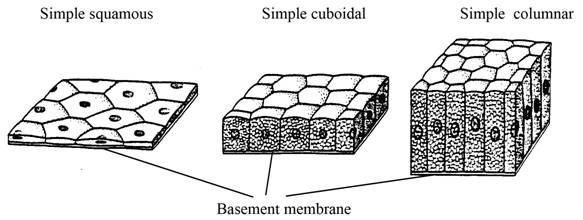
Epithelia are classified on the basis
of the number of cell layers and the shape of the cells in the surface layer.
* If there is only one layer of
cells in the epithelium, it is designated simple.
* If there are two or more layers of cells, it is termed stratified.
* Cells in the surface layer are,
as a rule, described according to their height as squamous (scale- or plate-like),
cuboidal or columnar.

Psuedostratified epithelia appears
to be layered (stratified) because the cell nuclei occur in two or more levels
in a row of aligned cells

View Slides
| Type of Tissue |
Function |
Location |
| Pseudostratified
columnar |
removing dust and
particles from airways, has cilia |
lines the respiratory
passageways |
| Simple
Columnar |
Absorption |
lines the uterus
and most organs of the digestive tract |
| Simple
Cuboidal |
Secretion and Absorption |
glands, kidney tubules,
ovaries |
| Simple
Squamous |
Diffusion and Filtration |
lungs, walls of
capillaries and vessels |
| Stratified
Squamous |
Protects underlying
cells |
skin(keratinized)
and the throat, vagina, mouth (soft) |
| Stratified
Cuboidal |
Protection |
lines ducts of the
mammary glands, sweat glands, pancreas |
| Stratified
Columnar |
Protection, secretion |
male urethra and
vas deferens, parts of the pharynx |
| Transitional
(unstretched) |
Specialized to become
distended |
urinary tract |
***Once your are comfortable with
the types of epithelia, move onto the QUIZ.
You may use your notes and drawings.